Friday, June 19, 2015

Strike up the Band! Let Summer Begin!


Follow the L.L. Bean boot!
In Bath time, summer begins the second weekend of June with a parade of events second to none! In order to arrive for the start, Joe and I packed up our “vintage” SUV and headed east on the fastest U.S. highways. In Ohio on the Interstate near Toledo, we spotted the L.L. Bean boot and followed it far into Pennsylvania before we lost it at a rest stop outside of Erie. The boot, of course, had a coveted Maine license plate. Our SUV, on the other foot (Get it?), had an Illinois license plate, but our bumper was sporting a large Bath sticker, and it was clear that both vehicles were going the same way!

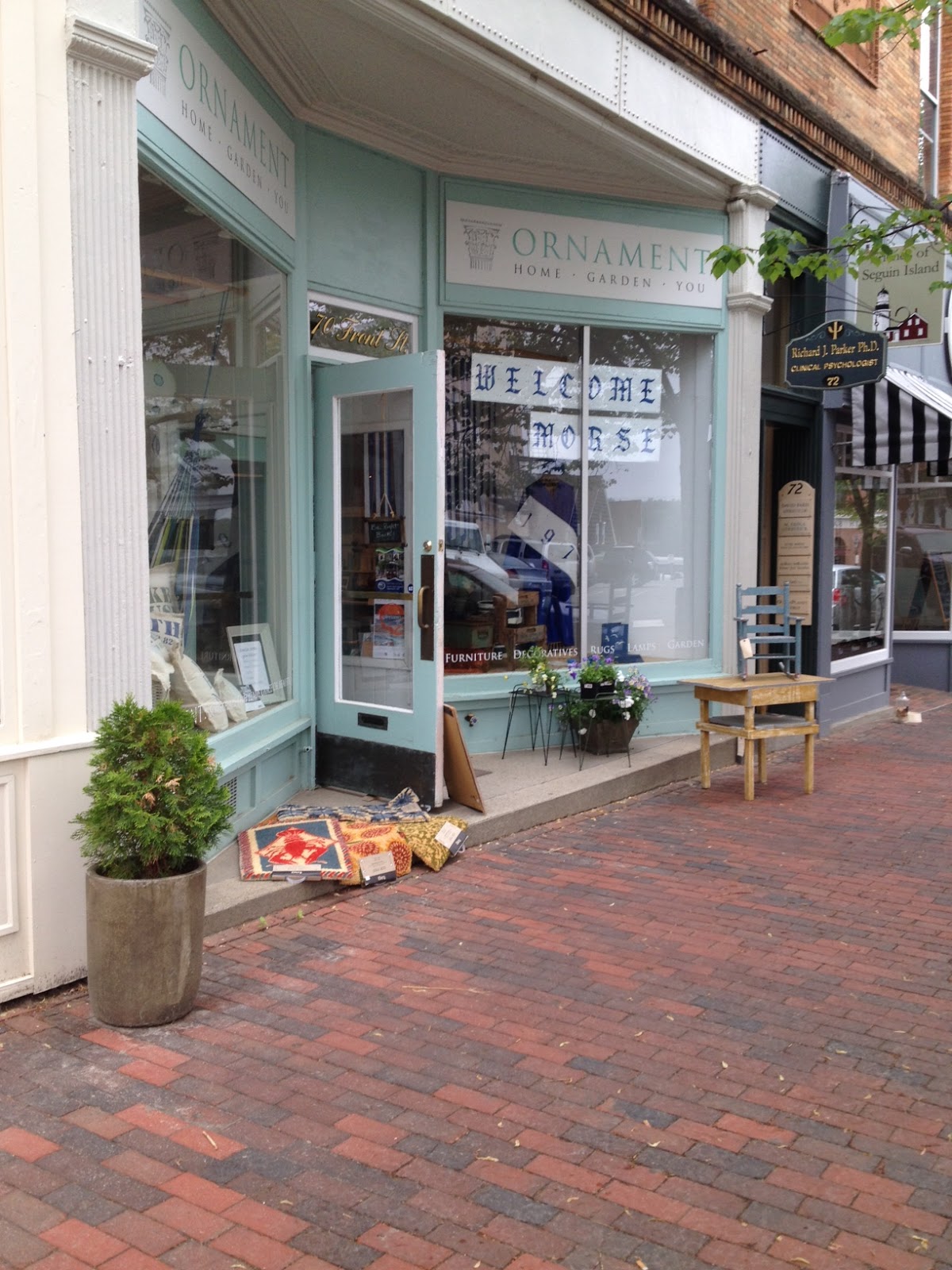
For Bathites, the high season climbs to full speed towards the Morse High School Alumni Association’s Reunion Weekend. As the oldest alumni association in the country, they set the standard for reunions! Morse welcomes their returning graduates with a blue and white banner across Front Street, a score of shop windows displaying old yearbook photos and letter jackets, and wide open doors at all of the local inns, taverns and restaurants around town. This year Maine’s Cool Little City seemed to be humming as early as Wednesday night because that’s the night we arrived from Chicago to find there wasn’t a single vacant seat at Byrnes’ Irish Pub on the tenth of June! Except for the absence of snow, last weekend felt a lot like Christmas in downtown Bath. Everyone was saying hello with a hug, and lots of people were out strolling. They were telling stories and laughing at old, familiar jokes. Their joyful sound seemed to cast a silvery net around hearts that will be forever young when they come home to Bath.

The Mitchell School (a.k.a. Universe Gym) is 100 years old.
 Officially, the first big party of summer was Friday night’s 100th Anniversary celebration of the Mitchell School at 361 High Street. Today this impressive brick building is home to the Universe Gym and Fitness Studio, which has been owned and operated by Bath’s native son and daughter, Shane and Kari McKenna, since 1996. The building was originally designed by Lewiston architect Harry S. Coombs as a primary school for children in the South End  and was praised for its fire safety because it was built with two stairways at opposite ends. As a high school teacher who works in a three story building built in 1929 in Oak Park, Illinois, I salute the attention paid to safety. I also appreciate the large windows that allow for the entrance of natural, inspiring light! If Joe and I had not been busy preparing our house for the second big party of the weekend, Sagadahoc Preservation, Inc.’s 13th Annual House Tour, we would have been at Friday night's celebration to applaud the preservation of one of Bath’s genuine treasures! But as fate and Bath would have it, our house on Washington Street was scheduled to be the third “Marching Band” in Saturday’s parade of historic homes. We could almost hear the 76 trombones (a.k.a. docents)!

 Looking back, last weekend seems like a foggy dream. I believe Joe and I together greeted at least 200 people as they passed through our home, and that number of hellos can leave you dizzy.  For us, however, the most amazing aspect of the House Tour is how we became a part of it. Joe and I have only owned our home in Bath for two years, and last year we attended our first S.P.I. House Tour, which happened to take place in Phippsburg. Our participation in this classic Bath-style event seems impossible, but then that’s the magic of Bath!

A community filled with talented volunteers can make the impossible inevitable. How does magic happen? The director of S.P.I., Lorena Coffin, asked us to open our house to possibly 300 visitors and promised there would be docents to guide and watch-over the flow of people. She also offered flower arrangements for the dining room and entry hall, and I am a fool for flowers! Needless to say, Lorena convinced me that people would come if I only opened the door. I said, “Yes.” In turn, I persuaded Joe that it was the right thing to do if we were truly committed to preserving the beauty of this historic city of shipbuilders. How could he refuse? He said, “Yes!" Funny, a song that frequently plays in my head is Before the Parade Passes By. I‘m a fan of the Barbara Streisand version:

Flowers from the Bath Garden Club
Before the parade passes by
I’m gonna go and taste Saturday’s high life
Before the parade passes by
I’m going to get some life back into my life…

When the whistles blow
And the cymbals crash
And the sparklers light the sky
I’m going to raise the roof
I’m going to carry on
Give me an old trombone
Give me an old baton
Before the parade passes by…

We all choose different songs for our playlist. Clearly, I love parades, and the City of Bath loves them, too! You could call me crazy if I were the only person, who wanted to join the parade and play the trombone, but there were twelve houses/gardens on the tour, and many of the owners resembled Joe and I. On Thursday evening, we met the other homeowners and most of the volunteers at the docent meeting at the Winter Street Center. There were almost 80 docents who helped Bath throw the baton, blow the whistles and crash the cymbals during the House and Garden Tour. They were fabulous “musicians” who showed up as early as 9:30 a.m. to review the histories and distinctive architectural features of their assigned homes. I had the pleasure of volunteering with my musical daughter, Katie, as well as Roger and Sukey Heard, who were seasoned docents and helped me feel at ease. I was also honored to have the help of Polly, the owner of Brick Store Antiques, a store which captured our hearts and wallets when we first moved to Bath. After twenty years as a shopkeeper, Polly recently closed the store on Front Street, but she continues to be an active antique dealer in the region. Marilyn Reed, Bath’s famous tap dancer, also guided people through our home, and she did it in her signature pink shoes! Cynthia Galea rode her bike, with her readers and her guidebook in the basket, down the street to our place to direct the visitors upstairs. Joe, Katie and I feel as if we have made some new friends, and that is always a good feeling!

Can you see the glass door knob?
We learned a wealth of information from our docents and guests. One visitor from Phippsburg told me that the glass knobs on our doors were from the 1840’s, but the few brown knobs were from the later, Victorian era, and they are less unusual. A lady from Bath told Joe that we had great fireplaces and could restore them to full use without much trouble; another visitor from the area told us she had the same bannister in her house and knew that a father and son carpenter team made this federal-style bannister only between 1820 and 1840 here in Bath. After touring our home, a neighbor commented that she and her husband had shared their home on the House and Garden Tour four years ago, and even though they had lived in Bath for many years, they met new people and enjoyed the experience. Joe and I agree. By opening our doors to the community, we not only helped support the preservation of Bath’s distinctive architecture, we also deepened our appreciation for our hometown. Bath is a place where people know how to build a caring community as well as strong ships!

Ornament's owner is a proud Morse alumna!
Truth be told, some mighty Bathites volunteered to help at multiple celebrations last weekend.  A few incredibly generous individuals were involved in all of them! I know for a fact that Marilyn Reed left our house and went directly to the Morse Alumni Reception to help serve refreshments. Of course, she was still wearing her fancy pink shoes! And the inimitable Ms. M., who was the chairperson for the entire crew of docents, was also attending the anniversary celebration of the Mitchell School as well as the 2015 Morse graduation! Her grandson graduated, and her daughter, Kari, celebrated her own Morse reunion in addition to celebrating her son’s graduation and the Mitchell School’s 100th Anniversary! That is officially a party weekend! The good people of Bath certainly know all the lyrics to Before the Parade Passes By, and they like to sing in perfect harmony! Even though I am not a graduate of Morse High School, I certainly enjoyed rocking and rolling with the Shipbuilders!

Now it’s full speed ahead to Heritage Days and the next parade, which will actually include real marching bands with real whistles and drums. I can hear that song, Before the Parade Passes By, playing in my head again:

Look at the crowd up ahead
Listen and hear that brass harmony growing
Look at the crowd up ahead
Pardon me if my old spirit's showing
All of those lights over there
Seem to be telling me where I’m going…


Saturday, May 2, 2015

Do The Lobster Stroll!


Summertime at Popham Beach
 For high school seniors, looking out of a classroom window in early May is like watching George Lucas’ 1973 coming of age drama, American Graffiti, on the big screen. You can almost hear the engines of those fast cars inviting Curt and Steve, played by Richard Dreyfuss and Ron Howard, to take a thrilling summer ride. Remember that All-American drive-in restaurant where those young California dreamers used to hangout? Well, that flashy drive-in reminds me of Fat Boys on Bath Road! Funny, as a high school teacher, I am also waiting for summer and root beer floats. However, unlike my seventeen year-old students, my idea of a wild summer is sitting under a sun umbrella at Popham Beach and reading Elizabeth Strout’s newest novel. On a perfect beach day, I will take a short, cool walk to Fox Island at low tide for a better view of the Seguin Lighthouse. If the tides and weather permit, I‘ll stay out on those rocks until sunset before slowly walking back to the sandy beach to take the easy ride home to Bath.

A lone lobster trap on the beach in early April
A few weeks ago, Joe and I had a chance to take a spring walk along a deserted Popham Beach. We only passed one other person on that chilly day. Like us, he was enjoying the peace of a quiet beach still in winter mode.  In the off-season, beaches seem to keep secrets, and, believe it or not, I am trained in unlocking secrets! We found a lobster trap that probably washed up on the beach during one of the February storms.  I wonder who is looking for this carefully designed trap, and where did the “too small to be caught” lobster go after he slipped out through the back door? Before the summer crowds arrive, beaches can be mystifying! Ironically, I saw Popham Beach for the first time on an April day two years ago, and it was love at first sight! In one salty moment, Joe and I decided that we wanted to spend the rest of our lives in Maine! Two months later we bought our Maine house, and we have been doing our happy, lobster stroll ever since!

A modern day image of lobster fishery on Monhegan Island
Catch a lobster if you can because they are key to Maine’s identity. One of the earliest stories in the maritime history of Maine is the arrival of an English ship, The Archangel, on the shores of Monhegan Island on May 17, 1605. A member of Captain George Weymouth’s crew, James Rosier, reported the first official Maine lobster landings: “And towards night we drew with a small net of twenty fathoms very nigh the shore; we got about 30 very good and great lobsters…which I omit not to report, because it sheweth how great a profit fishing would be…” (A Guide to Lobstering in Maine, DMR). Today, Maine’s lobster fishery is probably the oldest, continuously operated industry on the North American continent. It is also the largest lobster fishery in the United States. In 2012, Maine’s lobster catch was 127.2 million pounds, the highest catch since record keeping began in 1880.  Last year’s catch was not a record-breaking harvest, but lobstermen paid their bills and celebrated Maine’s healthy supply of lobsters!

A collage of buoys and flowers on the dock in Bath
It’s easy to see why so many commentators like to say with a wink: “You know you’re in Maine when you see lobster traps, buoys and other lobster materials decorating homes, restaurants and retail shops.” Simply stated, lobsters are enormously popular in Maine with good reason. Lobstering has fueled Maine’s entrepreneurial spirit since the 1840’s, but long before English explorers arrived at the mouth of the Kennebec, Native Americans were catching lobsters with their hands and using them to bait their fishing hooks and fertilize their fields. 

Lobster buoys adorn Seguin Island's old wooden trolley track
In colonial times, lobster was considered “poverty food” because it was abundant and easy to harvest. Indentured servants, who had paid for their passage to America by pledging seven years of servitude, were forced to eat lobster so often that some rebelled and demanded that their contracts be altered to limit lobster dinners to no more than three times a week. In sharp contrast, when I was twenty-one and responsible for paying my own bills, I refused to eat lobster because it was the most expensive item on the menu!

 History books tell us that Maine’s lobster fishery was endangered by the rise of the canning industry from 1840 to 1880; however, conservationists responded with guidelines to preserve the population. The first lobster pound appeared on Vinalhaven in 1875, and many others followed. These pounds  became the genesis of Maine's modern harvesting practice. As the canning industry collapsed, the fresh lobster industry grew. In other words, Mainers realized there was a need for conservation to save planet Earth almost one hundred years before it became a global mission! Today, harvesting lobster is a highly regulated business, but residents who enjoy fishing as a pastime can obtain a license to catch a few lobsters if they can!
A Maine memory antique trap and buoy
Maine lobstermen probably harvest and sell more lobsters than anyone else in the world. Brooks Trap Mill, a family owned and operated business since 1946, is the largest manufacturer of lobster traps in the state. According to an article in the Bangor Daily News (2013), former Senator Olympia Snowe recognized this stellar company for its invaluable contribution to Maine maritime history with an official notation in the congressional record in 2012. Before Michael Ojala, a Finnish immigrant, opened his first business, a sawmill on Rockland’s waterfront, he decided to Americanize his name by changing it to Brooks. In Finnish, “ojala” means a fast flowing brook, so Brooks was a good translation and a positive choice. Ironically, in Spanish “ojalá” means “I hope” or, more traditionally, “God grant.” Okay, I am a Spanish teacher, and as fate and Bath would have it, I also have a little Finnish blood in me on my paternal grandmother’s side. I have digressed, but in addition to highlighting the Finnish connection, I have to recognize God’s grace in Maine’s lobster fishery and Michael Brooks’ success story. In 1949, with the help of his sons, Michael moved his sawmill closer to his family’s home in Thomaston. Despite a few setbacks, Brooks Trap Mill expanded from sawing trap stock to making wooden traps and later, in the 1980’s, wire traps. In fact, under the direction of Karl Brooks, Michael’s son, the company custom-designed wire cutting machines that enabled it to produce high quality traps quickly. Almost 70 years later, Karl’s three children, Mark, Julie and Stephen, now own and operate three warehouses and four retail locations, including Portland Trap, Brooks Marine Supply (West Bath), Downeast Trap (Jonesboro), and Brooks Trap Mill. From Nova Scotia to Connecticut, Brooks’ traps are catching lobsters. Even though I am not a commercial lobsterman, I would like to visit the Brooks’ store in West Bath to walk among the giants of the industry!

The spectacular view from behind Five Islands Lobster Co.

If you appreciate lobster, but never catch them, I recommend a visit to Five Islands for a close-up look. Whenever Joe and I entertain friends “from away,” we offer to drive them over the Sagadahoc Bridge to Georgetown. When we arrive at the edge of Sheepscot Bay, we stop to admire the cold blue water and the pretty boats that are waiting for their crews. We also take a minute to snap a few pictures of the scores of lobster traps sitting on the dock. After we fill our souls with all that natural beauty, we invite our guests to order a lobster lunch at Five Islands Lobster Company. I’m convinced the lobster tastes better at Five Islands because you eat outdoors, and the friendly servers are willing to give you advice on how to eat a lobster fresh out of the pot. A visit to Five Islands is the best education you can buy Downeast! On our way back to Bath, we usually stop at the Doubling Point Lighthouse to make a wish along the Kennebec and say thank you for another great day in Maine!


When day is done, I have come to realize that the only difference between my seventeen year-old students and me is forty years! Everything changes and everything remains the same. When May turns to June, it's time to go out and play.

The teacher has left the building! She is probably out doing the lobster stroll!
It's possible to find a blue lobster in Maine!


Saturday, April 11, 2015

Time in a Bottle


Vestiges of the shipyards along Long Reach
When your middle child turns thirty, you suddenly want to shout: “Stop the clock! Time out!” At least that is how I felt last Monday when Matthew celebrated his 30th birthday at our home in Bath. As he blew out all those candles in one strong breath, we sang Happy Birthday, but I was thinking Time in a Bottle. And yes, I am a huge Jim Croce fan.

If I could "save time in a bottle," I would fill 1,000 bottles with stories from the Kennebec, especially Bath’s Long Reach, and I would share them with my children in hopes they would share them with their children because they are imbued with authentic courage, vulnerability, and intelligence. In his book Live Yankees, W.H. Bunting refers to the residents of Bath as Bathites, and he credits their success and longevity to their ability to adapt. Bathites know how to flow with the river and change as time goes by. This city of shipbuilders has managed to update and modernize without loosing its essence, its history. In a recent Boston Globe article, Bath was described as “lumber sexual chic.” The hard-nosed reporter, who was initially skeptical of Bath’s nickname, ultimately concluded that Bath was “on the edge of cool.”
Drawing with pastels at 411 Front Street, the old shipyard office

This cool, chic little city in Maine is clearly the right place to fill a bottle with time. On Monday morning, April 6th, at 9:30 a.m., the precise day and hour to celebrate my middle child's 30th birthday, Matthew walked around the corner to 411 Front Street to have an art lesson with Claudette Gamache, a renown artist who draws stunning landscapes with pastels. As fate and Bath would have it, 411 Front Street once served as the office for first the Patten and later the Sewall Shipyards. Today Claudette lives and draws in this charming house, which has a breathtaking view of the Kennebec. If I could save time in a bottle, I would travel back to 1854, the best of times for shipbuilding in Bath, and I would capture some of that Yankee energy and cork it for a rainy day!
Claudette Gamache gives Matthew an art lesson 

I believe the key to living well is remembering the lessons of yesterday, and if you are looking for yesterday, an antique store is a good place to start! A true sign of changing times, however, is the rarity of genuine antique stores. More and more dealers are consolidating and showing their treasures in a cooperative mall setting. Perhaps it’s a more efficient way to do business, but for those of us who appreciate “old” there is reason to celebrate the endurance of New England Antiques on Front Street and to welcome the new kid in town, The Old Bean Antiques, at 735 Middle Street.
After a weekend of frolicking with our three adult children and their sweethearts, Joe and I were feeling the hole their departure leaves, so we set out to look for artifacts from yesteryear, and we found a few at the Bean. First, Joe spotted the old telephone pole insulators in blue, yellow and clear glass lined up neatly on shelves by the front window. Of course, I had no idea what they were or how we could use them, but Joe explained that these glass caps were used to insulate the wires on the top of poles, and it’s rare to find them intact. He thought we could use one as a paperweight on our old library table. My new task was to look through the rows of glass to find the best one. Joe knew this quest would keep me busy for a while, especially since I spied the inimitable Ms. Joanne M. browsing nearby. I could certainly chat and look at the same time! Meanwhile, Joe moved toward the old books in the far corner. This is a fairly typical maneuver for Joe, and he usually finds a book that intrigues him. Par for the course, he found an 1891 book on the Chicago World’s Fair with some amazing illustrations and a binding that was slightly broken, revealing a strip of an old newspaper that offered subscriptions for 39 cents. Since Joe had worked in the world of Chicago publishing for many years, this was a definite hook. We purchased the “Made in America” glass collectible, but Joe would think about the book.
A book published in 1891 found at The Old Bean
A few days later, we returned to The Old Bean for a second look. It was a good visit because we had a chance to speak with the owner, Melissa, who was able to share the back-story on the World’s Fair book. Truth be told, the book was part of the Percy's library, and when the old Percy house on Middle Street was being emptied, Melissa purchased as many books as she could. Although I am not familiar with the Percy house, I do remember seeing the name Percy engraved in the sidewalk in front of Reny’s on Front Street, and I also remember seeing a picture of David T. Percy & Sons Department Store on my 2014 Historical Society calendar. (Why do I remember random details like this?)  In Bath's boom year of 1854, D. T. Percy, Sr. married Adriana Bosworth and went on to have seven children, three of whom became physicians. Percy’s Department Store was known as “The Busy Bee Hive.” The facts indicate that Mr. Percy was a man ahead of his time because he clearly achieved a healthy, happy work-life balance! 
Before Reny's, there was a Percy's

When I am walking along the streets of Bath, I feel like a time traveler, and that feeling is as thrilling as a ride Back to the Future with Michael J. Fox in a shiny DeLorean sports car equipped with a flux capacitor. The desire to travel through the time space continuum is universal. For Joe and I, our house on Washington Street is like a time machine. The research of Sagadahoc Preservation, Inc. indicates that our house was moved to its present location in 1856; however, Thomas Agry built it circa 1823. Thomas, the son of a shipbuilder and a Revolutionary War veteran, was born in Pittston, Maine in 1788. He served in the War of 1812 as a lieutenant, and in 1814 he married Elizabeth Webb and worked in Bath as a bank cashier until his death on December 24, 1851. Thomas and Elizabeth had six children, but sadly only three reached adulthood. The Agry family lost their home between Pearl and York Streets due to financial misfortune. Elizabeth died at the age of 47, and Thomas remarried. If one dwells on the sadness of the past, its harshness can stop the human heart. The fact that the Agry family was blessed with a son named Thomas who lived to father seven children and enjoy a life in Bath as a wheel maker allows our collective heart to keep beating and hoping. Perhaps I am a cock-eyed optimist, but I would rather dwell on happy days and let the sad ones fade away.


If I could travel back in time, I would like to arrive in Bath on January 5, 1814 and attend the wedding of Elizabeth and Thomas. Elizabeth was the daughter of William Webb and Elizabeth Crooker Webb. In 1788, her parents built a home on the northwest corner of Summer and Front Streets. This house was torn down in 1889, and the Patten Free Library was built on the same lot. How do I know this? The Bath Historical Society’s 2013 calendar has a photograph of the house on its September page! As fate and Bath would have it, our federal style home on Washington Street, built by Thomas Agry, a son-in-law of William Webb, resembles the Webb house.
A page from the Bath Historical Society's  2013 calendar
I know that saving time in a bottle is impossible, but traveling back through history is entirely possible if you visit the history and genealogy room on the second floor of the Patten Free Library. Recently, I visited the library and had a chance to speak with Judy Barrington, one of the founders of S.P.I., about Bath's changing landscape. History leads us to believe that Bathinites are both builders and movers! It was Judy who told me about the house that used to stand between Summer and Front Streets. If she had not mentioned it, I would not have remembered the photo I had seen, and I would not have connected Elizabeth Webb Agry and Elizabeth Crooker Webb and the fact that the original owner of my house grew up in a house where the library is now located. Why is this important? As time goes by, it helps me understand why I was so drawn to our house, and why I feel so happy when I am in it. The history wraps around me like a warm blanket on a snowy April day in Maine! Libraries, classic movies, old photos and maps, antique glass and old books all help us connect with the past, and they help us to imagine the future, too. What will it all look like thirty years from now when my middle child turns sixty? 

Sunday, March 8, 2015

Photo Booth Bath


City Park 2015 (Facebook treasure)
Glass plate photo of the Dirigo
On the corner between Summer Street and Washington Street, there is a winter mermaid officially known as the “Spirit of the Sea.” In 1959, the Bath Garden Club commissioned the nationally acclaimed William Zorach of Georgetown, Maine and New York, New York to sculpt this mythical figure in bronze. Upon its completion in 1962, it arrived in Bath to become a permanent resident. Throughout the year, this siren of City Park calls us to the little bridge near the library to admire the beauty of our City of Ships and revel in its capacity to create a four-masted steel bark like the Dirigo, built at the A. Sewall & Co. shipyard in 1894, as well as a Zumwalt-class destroyer, built at Bath Iron Works in 2013.
A  1950  post card shows City Park's fountain before "The Spirit of the Sea"


View from City Park of Bath's Cosmopolitan Club
Every day of the week, you will find someone in City Park snapping a photo of the "Spirit of the Sea," recording the architectural splendor of the Winter Street Center, or capturing the charm of a street lined with Greek Revival style homes. In winter, spring, summer and fall, there will always be someone with an I-phone or an expensive camera standing on the dock at River Park capturing the glory of The Sagadahoc Bridge and The Carlton Bridge. In truth, Bath, Georgetown, and Harpswell, and all the Down East ports of Maine, create an amazing photo booth! All creative people who enter these charming places aspire to take amazing pictures and send them to the one they love!  

1928 post card view of the Carlton Bridge (mainememory.net)
Last fall, Sagadahoc Preservation, Inc. presented a lecture by Earle G. Shettleworth, Jr., the director of the Maine Historic Preservation Commission, entitled “Greetings from Bath, Maine: A Collection of Bath Post Cards.” Much to my chagrin, I was unable to attend Mr. Shettleworth’s talk, but I was captivated none the less by the notion that from 1900 to 1950, the phenomenon of post cards created a pictorial history of America. Today, the post cards we used to receive in our mailboxes and collected in shoe boxes have been replaced by thousands of Instagram messages. Frequently, post card like images appear on our Facebook page, and sometimes they show up on random blogs like Bath Time. Just like railroad cars, automobiles and airplanes transformed the way we travel, technology has altered the way we capture our Kodak moments. The new technology for taking pictures is so available that we don’t believe anything we see is important or meaningful until we record it for eternity Online. If we were to pause and reflect on the permanence of these images we are sending into cyberspace, we might stop and decide not to publish. In the face of great beauty, however, we feel a strong urge to point the camera and snap the picture. As fleeting as beauty can be, there is no time to hesitate. As fate and Bath would have it, living Down East is synonymous with wishing for a more expensive camera! 


Cook's Lobster House in ice by Steve Yenco
When I think of Bath and its coastal neighbors as a photo booth, I also think of Steve Yenco of Mainly Maine Photography and Ben Williamson of Benjamin M. Williamson Photography. In January, February, and March, these two visual artists rescued me from winter despair with their pictures of Cook’s Lobster House and “The Old Shack,” a.k.a. “The Nubble,” on Bailey Island. In two quick crystal moments, they persuaded me to see winter as the prettiest season of the year! As a true girl of summer, born on the twenty-seventh of July, I call that magic!  


"The Old Shack" (The Nubble) by Benjamin Williamson


Vintage post card of The Nubble (mainememory.net)
Ironically, last summer I visited the three islands that form the town of Harpswell for the first time, and I too tried to capture the beauty of Sebascodegan Island, Orr’s Island and Bailey Island with my camera. The contrast between the summer pictures that I took from the Cribstone Bridge and the winter images snapped by Yenco and Williamson are truly dramatic. Truth be told, I stumbled upon Bailey Island and its one of a kind bridge by accident. It was a spectacular July day, and I just felt the need to drive down Route 24 along the 216 miles of coast that define the picturesque town of Harpswell.

View of the Cribstone Bridge from Orr's Island (July 2014)
When I reached the Cribstone Bridge, I marveled at the sight, parked my car and walked along the bridge’s pedestrian lane. On that same day, there was a camera crew and a striking television reporter taping an upcoming show. We all chatted briefly about the breathtaking view, and I started taking pictures with both my camera and my I-phone in case one of them should tragically fall in the water. Capturing the images of Orr’s Island and Bailey Island became the mission of the day. The bronze marker at the end of the walkway confirmed my belief that this was indeed an important, historical place. Opened in 1928, the 1,150-foot bridge that connects Orr’s Island to Bailey Island was designed by engineer Llewelyn N. Edwards with an open cribbing. This unique design allows the tide to flow freely.  The lattice of 10,000 tons of granite slabs also promised that the bridge would be able to withstand the crushing blows of ice chunks that would inevitably strike it during the mighty winters of Maine! The amazing photos taken this winter by Steve Yenco and Benjamin Williamson demonstrate the force of Maine’s winter and the engineering genius of the Cribstone Bridge!

Morse Lobster House, Bailey Island (July 2014)


Early morning view of the Sagadahoc Bridge by Carolyn Lockwood
The cameramen, and women, of Bath have been pointing their cameras at phenomenal bridges since the turn of the twentieth century. In fact, post cards from the 1920’s capture the construction of Bath’s Carlton Bridge in 1927. Until the opening of the Sagadahoc Bridge in 2000, the Carleton Bridge offered the only dry pathway over the Kennebec River for people, trains and automobiles traveling north to Woolwich. Today, the Sagadahoc Bridge is an intrinsic part of historic U.S. Route 1. As MDOT’s first design-build project, it also boasts a six-foot wide bike lane and a six-foot wide barrier protected sidewalk. Nevertheless, its greatest claim to fame is its popularity as a subject among the photo booth groupies of Bath! I must admit I am becoming one of those groupies! However, the director of Maine Street Bath, Carolyn Lockwood, is by far the coolest local champion of photography in Maine’s Cool Little City. She happens to dwell in a perfect spot for taking pictures of downtown Bath and the Sagadahoc Bridge. On many a cold winter night, hundreds of Bath residents delighted in the artistry of her photos.

The construction of the Carlton Bridge (1927 post card)

Summer in Bath
In winter, good and noble photographers have entertained us with dazzling images, and I believe they have proven that there is incredible power in the stillness of a single image. I would especially like to thank Steve, Benjamin, and Carolyn for their magnanimous gift to all of us. Their art has lifted us up during the coldest of Maine days! At this moment, summer can be viewed Online standing behind spring! I can almost smell the flowers. It's picture post card perfect!


Sunday, February 22, 2015

Blizzard or Not, Here We Come!


Snow days are not unusual in February, but two blizzards in one month will cause a media frenzy, stop cars, trucks, trains and planes, and make any travel except by snowshoe almost impossible. Valentine’s Day, however, falls in the middle of February, and I believe it is imperative that we celebrate love in a big way. I also believe my Valentine is a magician who makes the impossible seem inevitable, so we did manage to fly out of Chicago and into Boston on Friday the thirteenth and drive out to Worcester, the snowiest city in the nation, and attend Winter Homecoming at the College of the Holy Cross before driving northeast to Bath just minutes before another blizzard hit Boston. Miraculously, at 6:30 p.m. we sat down for a Valentine’s Day dinner at Solo Bistro in Maine’s City of Ships! What a wild ride, and isn’t it funny that we were not the only crazy optimists to brave the frozen highways and skyways in the name of love! Every seat was taken on Friday night’s American flight, and one man boarded the plane with a dozen flowers in his hand. Later, at Logan airport, I saw that young man give the flowers to a young woman who was waiting for him at baggage claim.  All those strong winds and cold snow could not stop Cupid’s arrow! 

Truth be told, my Valentine and I were looking forward to meeting a creative band of people on Monday, February 16th, at the grand opening of The Mustard Seed Bookstore and Tea Shop in Bath. I was especially eager to meet the owner, Julie Shea, because I had read about her plan to reinvent The Bath Book Store in a new space. Before I even met her, Julie Shea reminded me of Kathleen Kelly, the gentle, but determined owner of The Shop Around The Corner in You’ve Got Mail, one of my all time favorite movies!

On Saturday, when we arrived in Bath, we couldn’t help but notice the walls of snow lining all the roads and covering most of the sidewalks. The City of Ships looked remarkably like a scene out of Walt Disney’s Frozen or Boris Pasternak’s Doctor Zhivago. Many of the doorways were barely visible from the street, but the snow covered rooftops stood tall and glistened in the evening light. On the up side, the snow had transformed Bath into a Winter Palace. On the down side, more than a few events would be cancelled because of the weather. I wondered if The Mustard Seed would cancel their opening day celebration. Julie Shea must have read my mind because she sent out a Facebook blast: Snow or not, The Mustard Seed would open on schedule! I could hear that Kathleen Kelly voice humming over the Internet chatter! For over a month I had been following the progress of Julie and Mike Shea’s labor of love. Supported by her associate Susan Shipsey and encouraged by their daughters, Julie and Mike transformed 74 Front Street into the coziest bookstore and teashop in Maine! On Monday morning, the day after Bath narrowly missed another blizzard, Julie, along with friends and family, turned the key and unlocked the door of the Mustard Seed. God and Mother Nature must listen to the prayers of Mainers!

Julie Shea with her daughter, Breelin

 Of course, there was no shortage of snow on February 16th, but inside Bath’s shop around the corner there was a glass case filled with freshly baked scones, a side table covered with an assortment of teas, and a wall decorated with dozens of tea cups. Simply stated, the Mustard Seed smelled delicious, and everyone who entered wanted to sit and stay for a while, but first they had to choose a teacup and just the right tea to savor the moment!

Joe and I roamed around the shop for a good fifteen minutes before sitting down to drink tea. I noticed the section for Maine authors first, and I had to pick up a copy of Olive Kitteridge to hold in my hands. Maine is spelled out in big birch letters on the back wall, and the nature books seemed to call Joe over to browse. I spent some quality time among the poetry books looking for my favorite poet, Billy Collins, an alumnus of the College of the Holy Cross, a two term United States Poet Laureate, and the author of “Snow Day.” How could he not be my personal favorite! In an article in The New York Times, Bruce Weber dubbed Billy Colllins “the most popular poet in America” largely because of his witty, conversational style. Weber went on to say, however, that Collins’ wit is only the lure to attract our attention so he can share with us a serious observation. At The Mustard Seed there is an old fashioned typewriter with a stack of library due date cards next to it. Those cards seem to be inviting us to sit down and type an idea. Julie may be a new bookstore owner, but she is experienced in the ways of teaching language arts, and she knows how to encourage us all to read more! Instead of asking me to fill out a form and place it in a suggestion box, Julie asked me to share my ideas about books that would be good for the shop via email. I quickly agreed to send her the titles of a few poetry anthologies by Billy Collins. Fulfilling that promise let me recommend two collections of poems that will help keep your imagination fully alive until spring: Questions About Angels (1991) and Sailing Alone Around the Room: New and Selected Poems (2001). As fate and Bath would have it, I think Julie Shea and Billy Collins are friends in spirit because they share the same passion: a love for reading. One of my favorite poems in Questions About Angels is “First Reader” because it reminds us all of our first encounter with the world of stories:

            I can see them standing politely on the wide pages
            that I was still learning to turn,
            Jane in a blue jumper, Dick with his crayon-brown hair,
            playing with a ball or exploring the cosmos
            of the backyard, unaware they are the first characters,
            the boy and girl who begin fiction.

I didn’t “look” for Dick and Jane at The Mustard Seed last Monday, but I did see a little boy about three years old with big blue eyes in between stacks of books. He was holding a blue balloon that almost matched his eyes, and he was trying very hard to tell me something. His words were not as clear as his gesture. He was offering me his balloon as a gift. It was opening day at The Mustard Seed, and he desperately wanted to share the wonder! At that moment, I was reminded of how important the gift of reading truly is and always will be. If we could read tea leaves, they would tell us that Julie Shea and Susan Shipsey have launched a great ship that will carry us to beautiful places and bring us back home with more stories to share.

On opening day, The Mustard Seed was brewing lots of tea for two  (I spied a young couple at a corner table), and tea for five (I spied a group of high school students at the big table by the window), and Julie even offered a cup of tea to the U.P.S. delivery man who arrived with a dolly loaded with boxes of new books. Sadly, the U.P.S. cannot stop to sip tea from a china cup, but Julie told the delivery man she would get some thermal cups to go for next time! At the end of the blustery, joyful day, Julie Shea probably went directly home and fell into bed, but I like to imagine that before she turned off the lights at 74 Front Street and locked the front door of her cozy new bookstore, she took a moment to twirl around the room with her daughters just like Kathleen Kelly used to do with her mother, Cecilia. Mothers and daughters deserve to twirl and dance, especially if they keep bookstores open for reading!

From behind the counter, Megan Shea and Olivia Shipsey help their moms open The Mustard Seed!


Saturday, January 24, 2015

Clear as a Bell and Other Four Letter Words


I heard Paul Revere’s bell on New Year’s Eve, and I looked up to see if I could spy the bell ringer, but my eyes could only see Old Glory waving from the top of Bath’s City Hall. It was a beautiful day to hear the sweet sound of liberty. The Paul Revere & Son foundry in Massachusetts cast 398 bells from 1792 to 1828 and 23 of those bells can still be found in Maine, but only four of the 23 were cast before Paul Revere died in 1818. Bath’s historic bell was cast in Boston in 1802, which makes it one of the four, a valuable part of a powerful American legend.

In a 2005 commencement speech at Vassar College, Tom Hanks, a living American icon, spoke poetically about our planet’s need for HELP and HOPE, both four letter words. I read his speech in The New York Times, and I quote it whenever I feel the need for crazy optimism and unflinching courage: “Take 100 musicians in a depressed port city in Northern England, choose John, Paul, George, and Ringo and you have Hey Jude. Take a hundred computer geeks in Redmond, Washington, send 96 of them home, and the remainder is called Microsoft.” College graduations usually remind us of the immense change that can occur over a four-year period of time, and Tom Hanks was painfully aware of the dramatic change that molded the Class of 2005. This was the class that came of age in the aftermath of 9/11. A consummate performer, Hanks opened his remarks by introducing a computer-generated solution to gridlock on Southern California freeways: remove four out of every 100 cars and the freeways will flow again. Hanks suggested we call this change “The Power of Four.”

As fate and Bath would have it, there is a connection between Tom Hanks and Paul Revere. It’s the power of four. There are four bells in Maine that were made by Paul Revere, the Boston silversmith who took a midnight ride in 1775 to alert the Minute Men that the British were coming, and I believe his bells still send a message of hope. The Revere bell in Bath is especially unique because it is the only one of the four that is found in the belfry of a city hall, not a church. One Revere bell is at the Christ Church of Gardiner, another is at the First Parish Unitarian Church in Kennebunk, and a third is at Saint Patrick’s Catholic Church in Damariscotta Mills. The fourth bell, the bell in Bath, took the road less traveled and that made all the difference!  

I believe Bath's bell is celebrated more because Maine’s Cool Little City reveres history more than most communities. Bells in America have always symbolized freedom, and The Midnight Ride of Paul Revere will always be a call for courage under fire. Ironically, in 1803, Bath’s bell chimed from the spire of the North Church on the northeast corner of High and Centre, not unlike the Old North Church depicted in Longfellow’s poem. When the congregation of the North Church built its Winter Street Church, the bell was moved to the Old Town Hall at the northeast corner of Centre and Water, and in 1929, one of the darkest years in American history, Paul Revere’s bell found its forever home at the top of the Davenport Memorial City Hall. Nowadays, it only rings on special occasions, and the person who rings it must be equally important.

On December 31, 2014, Leslie Trundy, a beloved guidance counselor at Morse High School, and Bath’s Person of the Year, did the honors. She rang in the New Year at precisely 12:00 p.m., not midnight. It’s a Bath thing, and it works well because everyone can gather at the Hallet’s Clock and sing “Auld Lang Syne." On that cold, winter’s day, Leslie was wearing a navy blue, U.S.A. Olympic beret made by Roots. I noticed her hat because we left City Hall together, and as we walked home, we shared some stories about our children and our running, two great joys we have in common. We walked fast and said goodbye too soon. On parting, I couldn’t possibly imagine how clearly I would remember her hat. A beret is so classically French that I was surprised when team U.S.A. chose it for the Winter Olympics a few years ago, but then a beret also suggests a bold spirit. 

"The Thinker" behind a bench at the Rodin Museum
Sadly, the reason I remember Leslie's navy blue beret so well is because one week later, on January 7, 2015, there was a terrorist attack in Paris at the offices of Charlie Hebdo, and a few days after that more lives were lost at a nearby kosher market. Chiming bells inspire us; blaring sirens frighten us. The sirens of Paris in January remind us that life and liberty is indeed fragile. As human beings, we all feel the terror of hate, and we all hope for peace. At night, when I walk my dog along Washington Street, I hear a church bell chime, and invariably at that moment I look up to see the stars and feel the freedom of the hour. It is simply beautiful.

Two chairs talking at the Jardin du Luxembourg
Truth be told, there’s a French connection in Bath. Both cities share a love of art, history, church bells and pretty places to sit and enjoy it all. My husband and I visited Paris for the first time last spring, and we sat in gardens; we rested near fountains, we dreamed in the shadow of breathtaking statues and we heard the bells of Notre Dame. In a similar way, people who work in Bath often eat lunch on pretty park benches beside people visiting Bath for the first time. Honeymooners staying at the local inns can French kiss on a number of secluded, or not so secluded, benches! And of course, there are many boats along the Kennebec that seat two or four or eight. There are so many places to relax and enjoy the river views and gardens. Whether you are sitting by the Seine River in Paris or the Kennebec River in Bath, you are free to read, draw, write poetry, play the guitar, talk with a friend, solve a problem, hope, pray and fall in love.
Add one more Parisian bench to make "the power of four"
The bell of Bath is historically significant because of the silversmith who made it, Paul Revere. In turn, Paul Revere is an American legend because of Henry Wadsworth Longfellow, the lyrical poet from Portland, Maine who wrote The Midnight Ride of Paul Revere after climbing the steps of the Old North Church “to the chime of bells” on April 5, 1860. According to the book cover of my treasured edition of the poem, this lone visit to the belfry of a church in Boston inspired one of the greatest historical poems in the American language. Many believe Longfellow, a graduate of Bowdoin College in Brunswick, Maine and a professor of French and Spanish at Harvard University, wrote the poem as a call to arms on the eve of the American Civil War. Historians may point out the inaccuracies of Longfellow’s account of that fateful night in 1775, but certainly it is the poetry of his words that make the event so unforgettable. Over 150 years after its publication, the Midnight Ride of Paul Revere still calls us to be courageous, and that is proof positive that art is more powerful than politics! Let freedom ring! Hope is everywhere!
Two sweethearts kicking back on the Kennebec!